Do trailing stops actually work?
The rule that promises to let winners run and cut losers short. We tested four trailing configurations across thirty pair-and-strategy combinations, spread included.
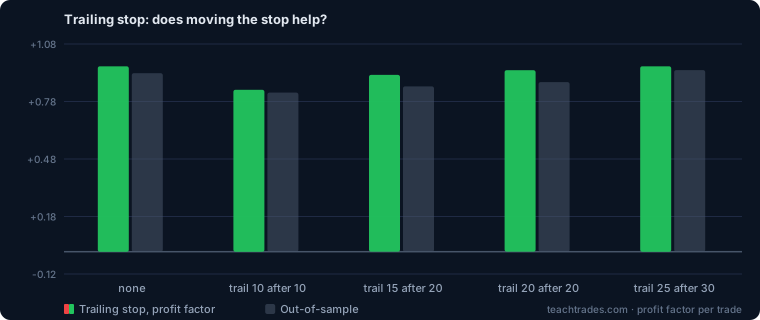
The claim being tested
Trail your stop behind price and you keep the upside of a trend while protecting what you have already made. In a backtest that never charges you for being stopped out early it looks close to free.
It is not free. A trailing stop converts a trade that would have gone to target into one that closes partway, every time price pulls back further than your trail distance — which, on a 5-minute chart, is most of the time. The tighter the trail, the more often this happens.
One detail decides whether a test of this is honest: within a single bar you cannot know whether the high or the low came first. Our engine tests the stop as it stood when the bar opened and only advances it after the bar survives, so no bar can both improve a stop and be rescued by it. Backtests that get this wrong make trailing stops look considerably better than they are.
The result
| Rule | Net pips, pooled | vs doing nothing | Avg PF | Out-of-sample PF | Beat baseline |
|---|---|---|---|---|---|
| none | -7,408 | — | 0.96 | 0.93 | — |
| trail 25 after 30 | -8,969 | -1,561 | 0.96 | 0.94 | 14 of 30 |
| trail 20 after 20 | -9,770 | -2,362 | 0.94 | 0.88 | 16 of 30 |
| trail 15 after 20 | -10,985 | -3,576 | 0.92 | 0.86 | 11 of 30 |
| trail 10 after 10 | -21,790 | -14,382 | 0.84 | 0.83 | 3 of 30 |
Reading the table. "Net pips, pooled" adds every run together rather than averaging them, so a combination that traded twice cannot outweigh one that traded three hundred times. "Out-of-sample PF" is the last 30% of the window, which none of these settings were chosen against — it is the column that matters, and it is almost always the worse one.
Why the in-sample number flatters everything
Any rule you add gives the backtest another dial to turn. Turn enough dials and the curve goes up, because you are describing what already happened rather than how the market behaves. That is why the out-of-sample column exists here and why it is usually lower: the settings had no knowledge of that stretch.
If a rule only looks good on the part you tuned against, you have not found an edge. You have found a coincidence and named it a strategy.
What this does not say
It does not say stop management is useless. It says these mechanical rules, on these strategies, over this window, did not pay for themselves. A rule applied with discretion, on a strategy with a different shape, over a different market, is a different experiment — one you can run yourself in a couple of minutes.
It also does not contradict our own record. Our trades move the stop to a level that locks in profit rather than to entry, and those closes average positive rather than zero. The numbers behind that are in what happens after a trade hits its first target.
Run it yourself
The strategy tester has the same break-even and trailing controls this used, on the same data. Change one number, watch the out-of-sample column, and see how quickly a promising result stops being promising.
Want the setups, not just the maths?
We publish every signal before the outcome is known, with entry, stop and three targets — and the losses stay on the record.
See today’s signals →